Showing posts with label Mahler. Show all posts

Tuesday, November 19, 2024

Youthful Artists, Mahler, Britten, Dazzle Seattle Audience


REVIEW

SEATTLE SYMPHONY, Benaroya Hall, Seattle

ERICA MINER 


Two youthful artists beguiled the Seattle Symphony audience with their dynamic performances in a vibrant program that highlighted the similarities and contrasts between early works of two composers who were connected in intriguing ways.

In his debut with the orchestra, Australian conductor Nicholas Carter chose to give the Seattle premiere of Benjamin Britten’s vivacious Piano Concerto, Op. 13, and Gustav Mahler’s Symphony No. 1.

Mahler was an inspiration to the young Britten, whose virtuosic concerto is full of energetic rhythms and bold orchestral colors. The performance of this early work was a tour de force for Benjamin Grosvenor, a pianist at the height of his musical powers.

Britten’s work, his first for piano and orchestra and his only concerto for the instrument, is brimming with exuberance and vigor. Premiered in 1938 at the London Proms with the 24-year-old composer as soloist, and revised in 1945, the inventive, mold-breaking and fiendishly difficult work was dedicated to British composer Lennox Berkeley. Previously paired by other orchestras with powerful Mahler pieces such as Das Lied von der Erde, there are moments that bring to mind Mahler’s much later Des Knaben Wunderhorn, as well as Britten’s mature operatic masterpiece, Peter Grimes. Described by Britten as “simple and direct in form,” in reality the concerto is a virtuosic opportunity for a pianist capable of exploiting its challenges, similar in many respects to Ravel’s Piano Concerto in G, with soupçons of Prokofiev and Shostakovich.

Grosvenor, acknowledged by Gramophone magazine as one of the top five pianists on record and known for his combination of brilliance and profound musicality, is one of those pianists. In his interpretation, he optimized both the technical and interpretative aspects of the piece so brilliantly as to seem a magician of the keyboard.

The first movement, Toccata: Allegro molto e con brio, gave Grosvenor the opportunity to make the most of the pianistic bravura. The pianist’s opening took off immediately with Shostakovich-like declamation and youthful exuberance as well as exactitude in his spirited pyrotechnics, which continued throughout the movement (what a pianist Britten must have been at that young age!) all the way to the Brahms-like flourish at the end. The huge orchestration showed off the players’ virtuosity its many textures: brass heavy, including special challenges for the high horns. Grosvenor's cadenza glissandi were both spectacular and tasteful. 

The Ravel-like Waltz: Allegretto second movement provided additional orchestral hues in the unusual duo between muted viola and piccolo with added solo clarinet, played with stylistic elegance by all three. Grosvenor exhibited sensitivity and clarity in his interpretation, again with phenomenal technical mastery.  

The movement was followed by the Impromptu: Andante lento, a theme and variations including a quasi cadenza section, in which Grosvenor performed with delicacy and touching introspection. March: Allegro moderato sempre a la marcia provided a smart ending for the work, evoking the first movement and driving toward a climax of rhythmic potency. Britten pays respect to his inspiration, Mahler, in the dotted rhythms and in the challenging trumpet fanfares. The soloist brought the piece to an end with a rousing flourish that brought the audience to their feet.


With Britten’s concerto providing a robust opening, the festive atmosphere continued with Mahler’s ever popular Symphony No. 1 in D Major. The work is astonishing in that the young composer was courageous enough to include panoplies of orchestral delights in his first symphonic effort evoking a gamut of emotions, compared to Brahms, who waited until a more mature period of his compositional life to take on the symphonic genre. Mahler’s work reflects his own heroic journey as he envisioned it.

After the slow, Nature-inspired tranquil introduction of the first moment, the 28-year-old composer evokes his earlier Lieder eines farhrenden Gesellen (Songs of a Wayfarer) in the Allegro section, continuing the Nature theme derived from the words “Ging heut’ Morgen über’s Feld” (“I went this Morning over the Field”). Carter underscored the Wagnerian “Forest Murmurs” aspects of the piece with gentility and reverence.

The movement’s upbeat ending gives the robust Scherzo second movement notable impact, both in the beginning and in the wistful waltz of the middle section. Done with spirited movements from Carter, one could envision his leaping from the podium and dancing a Ländler

The third movement provides repeated contrasts between its funereal opening melody, the wild klezmer music that Mahler heard while he was growing up, and the introspective interval of delicacy in the middle section, again quoting Fahrenden Gesellen. Carter exploited the poignancy of the movement with gentle yet emotionally fraught gestures.

The stormy final movement was tempestuous and exciting. Carter contrasted the frenzied initial theme with the peaceful tranquility of the second theme, building to the ebullient climax and ending the evening with Mahlerian bravado and heroism, a bold and decisive personalized hero’s journey foreshadowing Richard Strauss’s Ein Heldenleben.

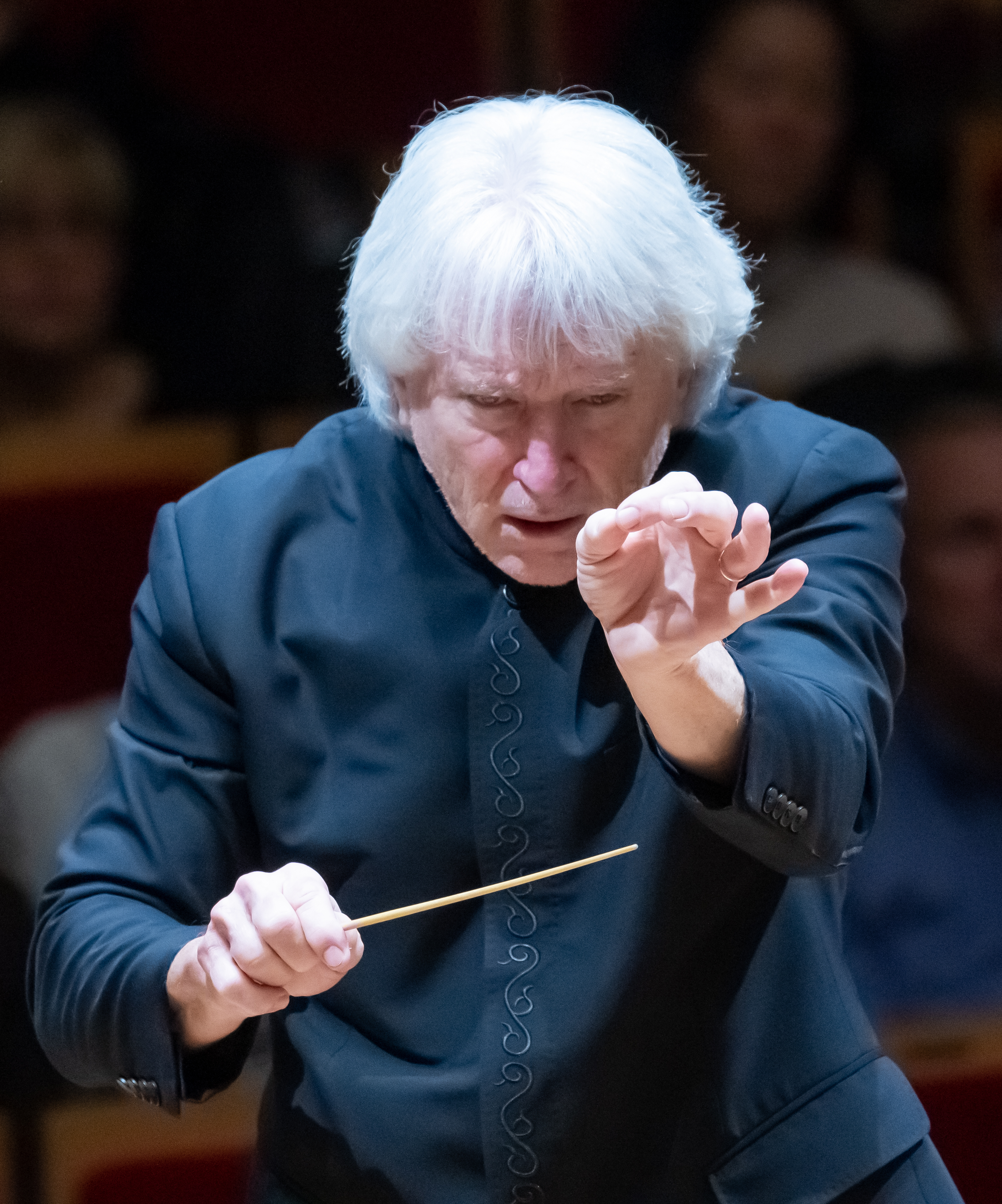
There is no doubt Carter is a born conductor and no surprise that his talent has been recognized by luminaries in his field, among them Vladimir Ashkenazy, Simone Young and Sir Donald Runnicles. Carter’s dramatic, perfectly paced rendering of the much-loved Mahler work showed great polish beyond his years and reflected his operatic background as Chief Conductor of Oper Bern, Switzerland. He is fascinating to watch, showing his joy with gestures that are exuberant yet always precise and controlled; ever energetic, at times seeming to levitate above the podium.

It’s no wonder the orchestra responded with an impassioned performance, demonstrating virtuosity in each section. Mahler’s First especially demands the ne plus ultra of trumpet playing. The musicians delivered on that challenge beautifully and consistently. Both monumental works were perfectly matched in their brashness and sensitivity, helmed and rendered with great panache by two outstanding young artists: a program to delight all tastes. 

---ooo---

Benaroya Hall, 200 University Street, Seattle, WA, Saturday, November 16, 2024, 8:00 p.m.
Images: Carlin Ma

Sunday, March 24, 2024

Mahler 5, Haydn, and Gabriela Ortiz at Pacific Symphony


The Pacific Symphony Orchestra, at very full strength, playing Mahler's Fifth Symphony under
guest conductor Carlos Miguel Prieto.

REVIEW

Pacific Symphony Orchestra, Segerstrom Center for the Arts, Costa Mesa
DAVID J BROWN

For the second time in under a week, we had a SoCal concert featuring an unusually long main work—but not quite long enough to fill the entire evening, and so bringing the challenge of how to populate a 25-30 minute first half. On Saturday, March 9, in Long Beach it was Brahms’ Ein deutsches Requiem with two well-chosen companion pieces (reviewed here); the following Thursday in Costa Mesa the Pacific Symphony Orchestra under guest conductor Carlos Miguel Prieto (left) gave us Mahler’s Symphony No. 5 in C-sharp minor, plus…?

The mighty Hoboken catalog of all the works by or attributed to Joseph Haydn (1732-1809) lists no fewer than six cello concertos but of these, two are deemed lost and two more labeled “spurious,” leaving just two actually surviving and performable—and even they had to wait until mid-20th century to be authenticated through the discovery of original manuscripts.

Joseph Haydn, c. 1770.
Haydn’s Cello Concerto 1 in C major, Hob. VIIb/1, composed between 1761 and 1765 for a star cellist in the court orchestra of his employer, Prince Nikolaus Esterházy, only resurfaced in 1961, but since then has become well established in the repertoire. Here it filled most of the available time in the first half, played by the young American cellist Sterling Elliott.

Given that the concerto is only scored for pairs of oboes and horns, the Pacific Symphony’s string strength was pared right down to 6-6-4-3-2, but with a spacious though strongly propulsive forward response to the initial Moderato marking, it felt like a “big” performance from the outset, within which Mr. Elliott’s playing was full of nuance, with singing tone, plenty of dynamic shading, and fleet as a gull riding thermals when needed.

Sterling Elliott.
The Adagio, notably slow even for that marking, was hushed and intimate, with the soloist’s tone reduced to the slenderest of threads at times, while the Allegro molto finale scurried deliciously, with dynamic contrasts sharply observed, and Mr. Elliott’s response as fabulously crisp as his playing in the slow movement had been tender. After a standing ovation, he came back for an encore, Julie-O, by Mark Summer (b.1958).

This concerto by itself would have been a perfectly decent first-half filler for a work as massive as Mahler 5, but Señor Prieta added a five-minute opener, Kauyumari by Gabriela Ortiz (b. 1964), which had been commissioned in 2021 by the LA Philharmonic for its reopening after Covid.

Gabriela Ortiz.
Freighted with native Mexican symbolism and connotations (Kauyumari means “blue deer,” a kind of spiritual guide), it opens atmospherically with distant trumpets against tam-tam strokes, but then devolves into constant repetition of a fast, syncopated Huichol melody, which with much textural elaboration builds to a frenetic climax.

In his opening remarks, Señor Prieta likened it to Ravel’s Boléro, but to my ears, it had more in common with Chávez’s Sinfonía India. Ultimately, however, it had neither the time-obliterating hypnotic quality of the former nor the hieratic grandeur and melodic memorability of the latter: a short, sharp, skillfully wrought occasional piece, delivered with whiplash response by the Pacific Symphony but as forgettable as it was easy on the ear.

The appearance of any symphony by Gustav Mahler (1860-1911) in a present-day concert program always takes me back to post-war Britain when, for a nascent music-lover with a taste for exotic and ambitious rarities, getting to hear any one of them, live or on the radio, was a treasurable once-in-a-blue-moon event. How times have changed! Now Mahler is so ubiquitous that the challenge for any performers is to somehow get beyond over-familiarity and re-ignite some of that sense of specialness.

Portrait of Mahler in 1902, by Emil Orlik.
However, the music itself is on their side. For those not allergic to works so overtly emotional and dramatic, each Mahler symphony charts its own specific and compelling journey, and the Fifth (1901-1902), the first of them to have no connection to the explicitly picturesque Wunderhorn world that permeates the earlier ones, is no exception. Across its unique three-part, five-movement structure it travels as far as any, from the peremptory trumpet-calls that open the first movement Trauermarsch (here delivered with snap-to-attention urgency by Tony Ellis) to the cloudless jubilation that ends the Rondo-Finale.

Though it’s neither scored for quite such huge forces nor is as long in duration as some of its fellows, the Fifth Symphony is, apart from the idyllic oasis of its fourth movement Adagietto, unremittingly turbulent and complex (indeed it is the longest of all of them in terms of measure count, a formidable 2704 bars) and remains a demanding, even exhausting, challenge to any orchestra, however skilled.

After that opening trumpet solo, the impact of the first fortissimo tutti before the funeral march gets properly under way, played by this great orchestra in the gorgeous Segerstrom Concert Hall acoustic, threatened to blow the fuse on any critical response to the performance as such, leaving one just reveling, ears agape, in the sheer beauty of the sound. And indeed, in terms of pacing, ensemble, dynamics, and grasp of structure, Señor Prieta and the Pacific Symphony seemed to me to nail the first movement.

Excellent too was the way they moved with only the briefest of pauses onto the second movement, or other half of Part 1 of the symphony, fully responding to its Stürmisch bewegt, mit größter Vehemenz (Moving stormily, with the greatest vehemence) marking. Later, Prieta’s way with the ländler second theme was richly expressive but never exaggerated.

However, when the great chorale erupted towards the end of the movement (marked by Mahler Höhepunkt (Climax) just so you don’t miss it!) it was, arguably, just a little too long-drawn and epically magnificent. After all, the movement does then collapse to a stuttering, exhausted end, and the greatest performances here do hold something back and convey by some alchemy that however triumphant the moment seems, it’s essentially precarious.

The centerpiece of Mahler 5, and comprising the whole of its Part 2, is the third movement Scherzo. It’s marked Kraftig nicht zu schnell (Strong, not too fast), and again Maestro Prieta got the speed, and the emphasis, just right. After an opening up-and-down fanfare by four horns, a fifth horn (labeled by Mahler Corno obligato) leads off the weighty dance revels; this Principal Keith Popejoy (left) delivered with robust fruitiness, standing up for extra prominence.

One past commentator labeled this movement a “symphonic ‘parody-Ländler’,” and for most of its length it is indeed a swirling, sonata-form dance hybrid rivaling Ravel’s La valse in its off-kilter savagery, scale, and textural complexity—and in this performance it was played with panache and relish to the hilt by the Pacific Symphony. But in the heart of the development the tumult draws aside for an extended solo by the Corno obligato; this was given a golden sunset aura by Mr. Popejoy (who oddly remained standing for the whole of the movement, even though there are considerable stretches where the Corno obligato does not play).

Mahler's composing hut at Maiernigg,
where he wrote the Fifth Symphony.
However… normally, this mighty scherzo lasts 17-18 minutes, but in Señor Prieta’s interpretation it stretched to around 20, due to what felt like an overly studied and drawn-out account of some of the slower passages, including the long, pizzicato-inflected lead back to the main action after the horn solo. This pulled the thread of continuity dangerously close to breaking-point, but was saved by the pinpoint precision of the Pacific Symphony strings and the eloquence of the woodwind and horn lines above.

This seeming self-indulgence led to concern that the famous Adagietto—the first of the two movements that with the Rondo-Finale comprise the symphony’s Part 3—would be an over-extended snooze-fest, but in the event Prieta’s tempo was once more ideal, bringing the movement in at around the nine-minute mark and keeping the music moving while the Pacific Symphony’s strings and harp (Michelle Temple) delivered it with melting eloquence and sensitivity.

Mahler marks attacca at the link between the Adagietto and Rondo-Finale, so that there’s no break between the former’s long fade to pppp (and yes, the Pacific Symphony strings managed even that extreme marking!) and the latter’s opening sustained horn note, by Mr. Popejoy now relieved of his Corno obligato label and seated. (This continuity is additionally useful now, so that tendencies towards inter-movement applause for the only part of this symphony that everyone knows is always rendered still-born.)

The Rondo-Finale proved to be the coping-stone on what was overall an extremely fine performance of Mahler's Fifth Symphony. After some built-in hesitancies, he marks the opening of the movement’s main body Allegro giocoso and Frisch (fresh), and Maestro Prieta established just the right mixture of the wide-eyed bucolic and the businesslike.

As the movement progressed he navigated its many discursions without losing grasp of the main thread, with the orchestra seemingly tireless in its articulation of Mahler’s relentless textural complexity so that the music continually danced. Maybe when the final repetition of the second-movement chorale arrived, juiced up by cascading strings, the massed brass showed the smallest signs of fatigue, but who could blame them? Certainly none of the roaringly appreciative audience, showing yet again how Mahler continues to beguile and enthuse 21st-century listeners. 


 ---ooo---

Pacific Symphony Orchestra, Renée and Henry Segerstrom Concert Hall, Thursday March 14, 2024, 8 p.m.
Images: The performance: Doug Gifford; Haydn, Mahler, and Mahler's hut: Wikimedia Commons; Gabriela Ortiz: Composer website.

If you found this review enjoyable, interesting, or informative, please feel free to Buy Me A Coffee!

Tuesday, January 17, 2023

Carl St. Clair Conducts Mahler’s Ninth Symphony


Carl St. Clair and the Pacific Symphony Orchestra perform Mahler''s Ninth Symphony.

REVIEW

Pacific Symphony Orchestra, Renée and Henry Segerstrom Concert Hall, 
Costa Mesa
DAVID J BROWN

Gustav Mahler.
After the final long-drawn notes of his epic 90-minute traversal of Gustav Mahler’s Ninth Symphony faded at last into silence, Pacific Symphony Orchestra Music Director Carl St. Clair kept his hands raised for longer than any other instance I can recall when a conductor thereby suspends applause at the end of a major work that ends with a descent into silence. Indeed, such was the effect of the wondrous Adagio which concludes this symphony that one felt the really appropriate response would be simply to depart in silence, as sometimes happens after performances of Bach’s Saint Matthew Passion.

When the applause finally came, it was long, heartfelt, and wholly earned both by the conductor for his meticulous and comprehensive response to Mahler’s masterpiece and by the orchestra for its skill and commitment, collectively and individually, in bodying forth one of the longest and most momentous journeys in all music. Had it been practicable, Maestro St. Clair’s spotlighting of individual players could with justice have extended to just about every one of the near 100 musicians on the platform, with all that collective and individual excellence enhanced for the fortunate audience by the Segerstrom Concert Hall's state-of-the-art acoustics.

Mahler with his daughter Maria.
The Pacific Symphony’s pre-concert publicity about Mahler’s Symphony No. 9 in D/D-flat major, as well as the (excellent) program note, understandably emphasized the three blows of fate which fell on Mahler during 1907—his departure from the Vienna Court Opera, the death of his four-year-old daughter Maria, and the diagnosis of his fatal heart condition—and how these influenced the Ninth, which he began the following year.

In an exceptionally informative pre-concert talk, Dr. Alan Chapman drew attention to one Mahler biographer’s view that his major works could notionally be grouped into trilogies, in the last of which the Ninth is the central member of the group that also includes Das Lied von der Erde and the unfinished Tenth Symphony—and thus may not be heard as a final death-greeting utterance. And alongside these views, the conductor’s own brief but heartfelt introductory remarks characterized the arc of the work as passing from “realization” in the first movement, through “reflecting” and “rejoicing” (movements 2 and 3) to “resignation” in the finale.

The Ninth begins like no other Mahler symphony, with a hesitant, irregular rhythm, pianissimo, on the cellos, immediately mirrored by the fourth horn, which St. Clair’s mentor Leonard Bernstein, for one, believed to represent the composer’s own faulty heartbeat. But there is an answer—an arching, four-note phrase on the harp, forte and marked Resonanztisch, that will have immense importance as the first movement progresses.

Carl St. Clair.
That this harp entry was perfectly weighted, just loud enough and resonant indeed, was the first indication of how thoughtfully detailed the interpretation was going to be, an impression rapidly confirmed by the easeful unhurriedness with which, after a little imprecision of ensemble near the beginning, St. Clair and his orchestra laid out the movement’s elaborate thematic exposition. The initial marking is Andante comodo, and for once that “comfortable” (but not complacent!) indication seemed exactly fulfilled.

In broad outline the first movement comprises successive waves of music that progress from stasis, through increasing tension and elaboration, to climaxes that collapse—with the harp motif now hammered out on timpani—but then slowly begin to engender the next wave. Each wave draws together and develops differently the many thematic and harmonic elements until the final and most brutal climax-plus-collapse leads to a long-drawn coda.

This most elaborate of the Ninth Symphony’s four movements, if taken too slowly, can not only feel somewhat interminable but also give the impression of a completed whole after which the remainder of the work may seem redundant. To my ears St. Clair, with a duration of a little over 28 minutes, got the balance just right between giving the movement its appropriate epic breadth but without any premature sense of finality—in his terms, “realization” but not yet “resignation.”

Mahler's composing hut near Tobiach, Italy, where much
of the Ninth Symphony was written in summer 1909.
The second movement is initially “at the pace of a leisurely Ländler,” heralded by bucolic upward runs on the bassoons immediately answered by crisp clarinet flourishes—a perfect sense of “new beginning” after the long rigors and exhausted conclusion of the first movement—if not quite, in this performance, as Etwas täppisch und sehr derb (somewhat clumsy and very coarse) as Mahler also marks the opening.

What critically influences the unfolding of this movement, however, is that Mahler also labels the opening as “Tempo I” and then, some 90 measures on, a somewhat faster “Tempo II.” Finally, heralding what is to some extent the “trio” section of a very elaborate scherzo movement, we come to “Tempo III”, Ländler, ganz langsam (very slow). All three Tempi have several marked recurrences, and St. Clair’s scrupulous observation of each, and navigation thereto, together with ever more devoted and skillful playing from the Pacific Symphony, entirely avoided any “enough already” reaction to a movement that is pretty long for its content (17 minutes in this performance) and in less skilled hands can seem unwontedly garrulous.

With the third movement, the Rondo-Burleske, the work moves from “reflection” to “rejoicing” in St. Clair’s characterization. To me, this really doesn’t begin to cover it, as from the very start Mahler’s scoring gives an acid edge to the controlled tumult (those four flutter-tonguing flutes!). Eventually, after a long and seraphic interlude heralded by a solo trumpet, the tumult returns, lashed ever more violently to a Presto coda delivered here with life-and-death ferocity and precision by the Pacific Symphony.

Probably the last photograph of Mahler,
taken on his voyage in 1911 back from
New York to Vienna.
Though that coda is perhaps the stand-out virtuoso passage in this symphony, Maestro St. Clair’s handling of the preceding interlude was another signal instance of his masterful view of the whole work, its beauty—though fully expressed in exquisite playing—never indulged for its own sake but interpreted in the context of the symphony’s true homecoming to follow in the Adagio finale.

For this, St. Clair set a very slow opening tempo. This was one of those very rare instances in performances of Mahler’s Ninth Symphony where the finale, at around 30 minutes, was actually longer in duration than the first movement, but the overall vision, the majesty and intensity of the Pacific Symphony’s playing in its great central melodic unfolding, and finally the marvelously long-breathed control of the final page’s visionary Adagissimo kept any sense of over-extension firmly at bay.

Perhaps the strings even managed in the last few bars to achieve distinction between Mahler’s virtually impossible requests for pppp on the first violins, ppp in the seconds, pp for the violas, and ppp cellos, the whole body of strings marked ersterbend (dying) on their final, long-held chord. So death? Or “resignation”? Or acceptance?

The Tenth Symphony was still to come, fully conceived though with only two of its five movements orchestrated. But a truly great performance of the Ninth enables any and all of these conclusions to be valid, and underlines that a masterwork of this many-sided complexity always contains more than any words can express. 


 --ooo---

Pacific Symphony Orchestra, Renée and Henry Segerstrom Concert Hall, Segerstrom Center for the Arts, Thursday January 12, 2003, 8 p.m.

Images: The performance: Doug Gifford; Other photos: Wikimedia Commons.

If you found this review enjoyable, interesting, or informative, please feel free to Buy Me A Coffee!

Tuesday, May 10, 2022

At Mason House, Chamber Music Reads the Room


l-r: Steven Vanhauwaert, Alma Fernandez, Cécilia Tsan, Ambroise Aubrun.

REVIEW

Piano Quartet Masterpieces, Mason House, Mar Vista
John Stodder

For all but the most fortunate fans, most music we hear comes through a home stereo, car speakers or earbuds. No matter where it was recorded, we wrest it from that environment to ours. We might listen to the grandeur of Beethoven’s Ninth alone in bed, or an unaccompanied Bach violin sonata while staring through a windshield on the 405. It is easy to forget that before music became so portable, it was usually written for, and presented in, specific environments.

When we say “chamber music,” mostly we think of small ensembles, but the term describes the places where it was performed: not a “church, theater or public concert room,” according to the music historian Charles Burney, but instead a “palace chamber,” or in more egalitarian times, a private home.

A chamber is where over 50 classical music fans found ourselves on Saturday, April 9. Mason House, a small private home in Mar Vista, was remodeled a few years ago with the living and dining room combined into a performance space. Its most recent concert featured violinist Ambroise Aubrun, violist Alma Fernandez, cellist Cécilia Tsan and pianist Steven Vanhauwaert, who played Mason House’s Yamaha C-7 concert grand, with special German hammers to give a softer sound, ideal for chamber music.


What makes chamber music special is intimacy: the ability to hear the slightest change in how the players attack their instruments; how they navigate melodic passages that expand from one instrument to two, three or more, and fit their playing styles together. Chamber music is up close and personal. This concert was memorable in part because we in the audience could feel we were taking the journeys of these works along with each of the wonderful players, hearing nuances that would have been inaudible in a larger hall or outdoors.

Todd Mason.
It was the first Mason House concert of the spring, the kind of serene afternoon when one would expect to hear a piece like Mozart’s Piano Quartet No. 1, the program’s planned opener, but to commemorate Ukraine’s struggle against the Russian invasion, the concert began with Mason’s new arrangement of its National Anthem, whose title, “Shche ne vmerla Ukrainy i slava, i volia” translates to “The glory and freedom of Ukraine has not yet perished.” The anthem had the mournful yet proud sensibility suggested by those words, an anguish that Mason and the quartet conveyed nobly, given the powerful emotions this populist theme evokes today.

Mozart in 1782, three years
 before the composition
of his First Piano Quartet.
From a strictly musical perspective, the inclusion of this impactful piece at the top framed the concert as a study in contrasting emotions. To be sure, as David Brown’s fascinating introduction outlined, the concert was also a journey through the relatively unpopulated realm of the piano quartet, a rarer form than one might have guessed: the Mozart we heard was one of the first piano quartets to be published.

The Mozart performance exerted a steadying influence on audience emotions potentially inflamed by thoughts of war’s horrors. To be able to concentrate on musical details is therapeutic; like the string players’ bowing techniques and how they aligned them into one sound in unison passages, or the carefully modulated way in which Vanhauwaert would control his dynamics and presence within the ensemble.

Brown noted that contemporary audiences in 1785 were frustrated by this work’s “incomprehensible tintamarre of 4 instruments.” What I heard was delightfully comprehensible, and never dull. Mozart in his essence is the composer who presents his music as going in one direction—giving you every reason to think that’s where it’s going—and then plays beguiling games along the way to lead you to think something else might be happening, until you reach a point of surrendering any sense that you know where the piece was going—and then he takes you exactly where you expected in the first place, and you are grateful.

Alma Fernandez.
This quartet—a constant springtime cycling of sunshine, clouds and rain—also felt like a conversation between characters with such a close relationship they can finish each other’s thoughts. My scribbled notes are filled with laudatory comments on bowing, fingering, attacks on strings or keys: the touch of music, not just the sound. It felt brave of these musicians to allow us to hear so much of them, the miracle of their artistry being how the exposure only enhanced our enjoyment.

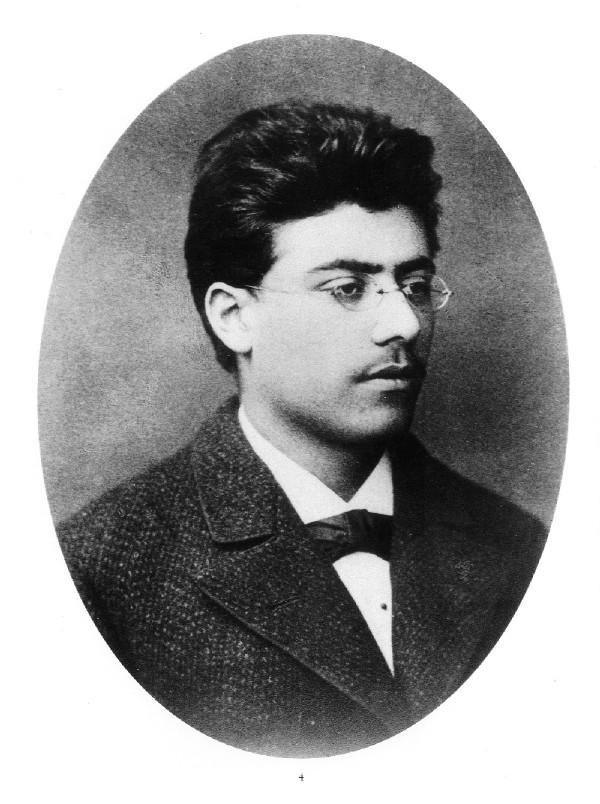
Mahler aged 18 in 1878, two
years after writing his Piano
Quartet
Movement.
The next piece, Mahler’s Piano Quartet Movement in A Minor, pulled us back into the maelstrom of emotions initially aroused by reflecting on Ukraine, then expertly diverted into a haze of joy by Mozart. Mahler’s quartet is notable, as Brown explained, for being the only work of chamber music he wrote that was not lost or destroyed. Mahler was a teen when he wrote it, but it contains the seeds of what his mature compositions are most known for: emotional turmoil, veering from joy to misery.

This piece walked a narrower path, from grief to melancholy to a kind of fearfulness that invoked our collective wartime moment. The quartet leaned powerfully into these emotions, their faces reflecting the mournful mood. It was a gift from the musicians to the audience to allow us to understand the depth of Mahler’s pain, to enable a catharsis. It is also a very different usage of the tools of chamber music, including the space itself and the intimacy it affords.

Brahms in 1886, the year of the Third Piano Quartet.
The first half’s dialectics of chamber music and emotion reached a synthesis after the interval, with Brahms' Piano Quartet No. 3 in C Minor. David Brown called it one of Brahms’ “major statements,” suggesting it is in the same class as other major statements from Brahms with which audiences are more familiar. If you have access to a music library, this quartet is worth seeking out for that reason; to make sure it is in your mind’s Brahms canon alongside the concerti and the symphonies. Whereas Mozart took classical structures and gently subverted them to his own imaginative ends, Brahms created structures that could carry everything he wanted to say, and made us believe that structure had been there forever.

Cécilia Tsan.
The quartet was up to the challenge, taking us everywhere Brahms wanted us to go, from the slowly awakening moments of the opening, to the light-as-a-cat touch on the fascinating, crowd-pleasing scherzo, to the heavenly cello-piano duet at the opening of the third movement, a gorgeous, complex meditation on the topic of deep emotion, as opposed to Mahler’s deep dive into emotion itself. This was mature reflection, with all four musicians rising to the needed rhetorical heights and guiding us to Brahms’ compassionate conclusion.

Ambroise Aubrun and Steven Vanhauwaert.
The fourth movement felt like, among other things, a showcase for the quartet’s virtuosity as well as for the players' mutual respect. Violinist Aubrun and pianist Vanhauwaert were spotlit early, with violist Fernandez and cellist Tsan added to the mix as the composer developed and discovered what he wanted to say in this finale.

In this final movement, I recall feeling as if Papa Brahms had pulled his punches a bit. The first three movements had teed me up for the kind of climactic resolution of his concert hall classics. But the fourth movement seemed more… polite? And so it was. This “major statement” was not a symphony or concerto, but chamber music. We don’t want to alarm anyone. We’re home.

---ooo---


Mason Home Concert, 3484 Redwood Ave., Mar Vista, CA 90066, 6:00 p.m., Saturday, April 9, 2022.
Images: The concert: Todd Mason; Mozart, Brahms: Wikimedia Commons; Mahler: Gustav Mahler website.

Wednesday, June 19, 2019

Mahler and Mozart(?) End the PSO’s 40th Season


The Pacific Symphony under Carl St. Clair in full cry in Mahler's First Symphony.

REVIEW

Pacific Symphony Orchestra, Segerstrom Center for the Arts, Costa Mesa
DAVID J BROWN

The Pacific Symphony’s 40th season came to its conclusion not with, as originally announced, Mahler’s all-choral, packed-to-the-roof, evening-filling Eighth Symphony (that experience is now promised for the end of next season) but with the more modestly-scaled but still pretty spectacular Symphony No. 1 in D major

The shorter first half was filled by another piece with a complicated history… and one that remains shrouded in probably never-to-be-resolved uncertainty. It is known, from letters to his father, that Mozart wrote a work in Paris, in 1778, for flute, oboe, horn, bassoon and orchestra, intended for performance by a visiting quartet of players. But it was never given, due, Mozart said, to chicanery between another composer and the concert promoter, who did not return his manuscript—which indeed was never seen again. 

Some 90 years later Mozart’s biographer, Otto Jahn, acquired a manuscript, not in Mozart’s hand, which was identified as his “Concertante” for oboe, clarinet, horn, and bassoon, with an orchestra of strings plus pairs of oboes and horns. Jahn had the score recopied by a professional copyist, and it was published in 1877 as the lost work.

Doubts about the Sinfonia Concertante's authenticity grew, however, and the majorly revised 1964 sixth edition of the Köchel catalog of Mozart’s works consigned it to its “doubtful and spurious” appendix. (To make a murky saga murkier yet, Jahn never revealed where he got that manuscript from, and after he died in 1869, it was nowhere to be found). 

On to the late 1980s, when the pianist and musicologist Robert Levin became so engaged with the mystery of the four-wind concertante that he devoted an entire book to it. He concluded that while the orchestra parts were probably spurious, the solo parts were basically genuine, with an unknown arranger recasting Mozart’s original flute and oboe parts for oboe and clarinet respectively. He then proceeded to a conjectural reconstruction of the original, with the solo parts re-reallocated back to the original quartet, and new orchestral parts based on his own deep knowledge of Mozart’s style in the late 1770s. 

The 1877-published Sinfonia Concertante in E-flat major for Oboe, Clarinet, Horn, and Bassoon, K.Anh C14.01, is still often played, but on this occasion Carl St. Clair chose to perform what was presumably (not clarified in the program booklet) the Levin reconstruction, with Mozart's original solo line-up of flute, oboe, bassoon and horn played by respective PSO section principals Benjamin Smolen, Jessica Pearlman Fields, Rose Corrigan, and Keith Popejoy.

l-r: Rose Corrigan (bassoon), Benjamin Smolen (flute), Keith Popejoy (horn),
and Jessica Pearlman Fields (oboe). 
Given this apparent commitment to musicology’s latest attempt to recreate Mozart’s original work, rather than a fallback to the familiar but spurious version, the actual performance was curiously lackluster. Though St. Clair reduced the PSO strings to around half their full complement, his treatment of the opening tutti was quite weighty and spacious; throughout there was a lack of dynamic nuance from the orchestra (perhaps Levin’s edition, if indeed that was used, is more sparing of dynamic markings than the old version). 

That said, the solo quartet were well matched (by and large the melodic materials are shared out pretty evenly, with all four getting solo moments in the sun and every combination of duet explored), and each player seized the opportunities for heartfelt eloquence in the Adagio’s melodic writing. The Andantino con Variazioni finale, though—again despite plenty of elegant work from the soloists—never really caught fire, with even the Allegro final section remaining at stubbornly low voltage. Perhaps the fact that all three movements are in E-flat major (in no other of his concertos does Mozart have all three movements in the same key) contributes to the work’s overall blandness? Perhaps (whisper it) it’s not really Mozart after all? 

Mahler in 1892, four years before the
Symphony No. 1 reached its final form.
After the interval, it was an entirely different story. I am old enough to remember when—at least in London in the ‘60s—Mahler symphonies in the concert hall were rare enough to be sought out and relished. Now, with Mahlerdolatory past the saturation point, one’s first reaction on seeing one programmed tends to be “again?... really?” And yet, a first-rate account of one of these behemoths still has the power to get under the skin and thrill and inspire an audience, and this was just what Maestro St. Clair and the PSO at beyond-full strength gave to theirs. 

Whether or not it’s the “greatest of all First Symphonies”, as St. Clair speculated in some opening remarks (after leading hearty congratulations to the orchestra at season’s end, in particular those who have been with it since its inception 40 years ago), the symphony's start—a sustained ppp A on all the strings over seven octaves—has a uniquely vernal and premonitory magic, and it was a tribute both to Maestro St. Clair’s balancing of forces and the Segerstrom Hall’s acoustic that the lowest of those seven octaves was just barely, but audibly, touched in, due to Mahler’s allotting it to only one-third of the double-basses. 

The opening’s sense of great things to come was intensified, after soft clarinet upward burblings, by ppp trumpet fanfares beautifully distanced and articulated by the PSO section offstage, after which the amiable main theme, borrowed from Mahler’s earlier Lieder Eines Fahrenden Gesellen, unfolded easefully and spaciously but with no lack of vigor when the exposition’s climax was reached (unsurprisingly, the repeat was not observed).

Carl St. Clair in action.
This pattern—of plenty of interpretative elbow-room combined with heft when needed, allied to playing as enthusiastically committed as it was sensitive—was maintained throughout the performance. There was much detail to be relished: a chunky, feet-stomping Scherzo; just the right degree of glissando from the violins at the start of the Trio; the ear-tickling clarity of section leader Steven Edelman’s muted piano solo double-bass at the beginning of the slow movement; a perfect sharp-intake-of-breath pause before Maestro St. Clair unleashed the storm at the beginning of the finale. 

One niggle: please can the epithet “Titan” for this symphony, used in the PSO’s pre-concert publicity, henceforth be put back to bed in the work’s early history where it belongs? The title was drawn from a romantic novel by one Johann Paul Friedrich Richter (“Jean Paul”), but Mahler dropped it after two performances of the symphony in its first, five-movement, symphonic-poem guise, and never used it again. 

In any case, the expectations “Titan” may arouse of something granitically Eroica-like sit ill—to this listener at least—with the symphony’s potent and highly original blend of nature painting, peasant dance, klezmer-inflected irony, and in the finale, extravagant rhetoric at each end of the emotional spectrum from despair at the start to bombastic triumph at the end, where it was to Maestro St. Clair’s credit that he made Mahler’s protracted roaring and trumpeting (almost) seem justified. On to the mighty Eighth this time next year! 

A standing ovation—of course...

---ooo--- 

Pacific Symphony Orchestra, Renée and Henry Segerstrom Concert Hall, Thursday June 6, 2018, 8 p.m.
Images: Orchestra and conductor: Doug Gifford; Wind soloists: Steve Dawson; Mozart: Esprit International; Mahler: Wikimedia Commons.


If you found this review to be useful, interesting, or informative, please feel free to Buy Me A Coffee!